

Table of Contents
- Why Cambodia Is One of the Best Budget Travel Destinations in Southeast Asia
- Is $30 a Day in Cambodia Actually Realistic? The Honest Answer
- Cambodia Budget Travel Guide: The Best Cities and Regions to Visit
- Where to Stay in Cambodia on a Budget
- Cambodia Budget Travel Guide: Food — Eat Like a Local for Under $8 a Day
- Getting Around Cambodia on a Budget
- Angkor Wat on a Budget: The Complete Guide
- Best Free and Cheap Things to Do in Cambodia
- Cambodia Budget Travel Guide: Beyond Siem Reap
- Cambodia Budget Travel Guide: Money, Safety and Practical Tips
- My Real 10-Day Cambodia Budget Breakdown
- Cambodia Budget Travel Guide: Best Time to Visit
- Frequently Asked Questions
1. Why Cambodia Is One of the Best Budget Travel Destinations in Southeast Asia {#why}
The Cambodia budget travel guide that tells you the truth begins with this: Cambodia is one of the most extraordinary, most affordable, and most misunderstood countries in Southeast Asia.
Most travelers know Cambodia for one thing — Angkor Wat. The largest religious monument on earth, rising from the Cambodian jungle in a complex of over 1,000 temples spread across 400 square kilometers of the Angkor Archaeological Park. It is, without question, one of the wonders of the world — and it is surrounded by a country of equal depth, complexity, and beauty that most visitors miss entirely.
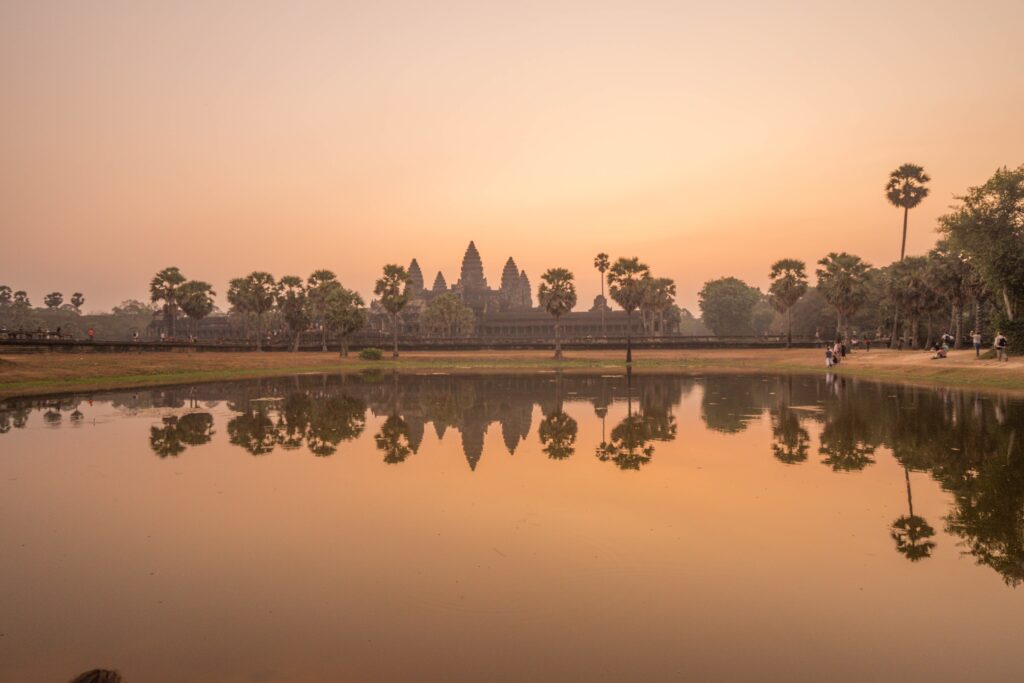
I spent 10 days traveling Cambodia from Siem Reap to Phnom Penh to Kampot to the coast. I hired tuk-tuks, took local buses, ate fish amok at roadside stalls for $2, stayed in guesthouses with swimming pools for $12/night, and watched the sun rise over Angkor Wat from the reflection pool with my shoes off and the stones cold beneath my feet.
My average daily spend across all 10 days: $27.40.
That is not a number achieved through deprivation. The Cambodia budget travel guide at $30/day buys you private guesthouse rooms, excellent Khmer food, tuk-tuk transport, and the most significant archaeological site in Southeast Asia — all for a total budget that most travelers spend on a single restaurant meal in London or New York.
According to Cambodia’s Ministry of Tourism, the country receives over 6.5 million international visitors annually, with the vast majority focused on Siem Reap and Angkor. Yet Cambodia’s most compelling experiences — Phnom Penh’s complex history, Kampot’s riverside calm, the islands of the south coast — are equally accessible and in some cases even cheaper than the Angkor temple circuit.
This Cambodia budget travel guide covers all of it. Real daily costs, honest destination assessments, practical transport strategies, and the Angkor Wat tips that separate an extraordinary visit from an expensive disappointment.
For the complete Southeast Asia budget picture, read our best budget travel destinations in Southeast Asia guide. For everything Cambodia specifically, this Cambodia budget travel guide has everything you need.
2. Is $30 a Day in Cambodia Actually Realistic? The Honest Answer {#realistic}
Yes — and $30/day in Cambodia is comfortable, not restrictive.
Here is the honest Cambodia budget travel guide daily cost breakdown:
The $30 Cambodia Daily Budget
| Category | Cost |
|---|---|
| Accommodation (private guesthouse room) | $8–12 |
| Breakfast (local café or guesthouse) | $1.50–2.50 |
| Lunch (local restaurant or market stall) | $2–3 |
| Dinner (Khmer restaurant) | $3–5 |
| Tuk-tuk or local transport | $3–6 |
| One paid activity or temple entry | $2–6 |
| Snacks, water, coffee | $1.50–2.50 |
| Daily Total | $21–37 |
The Cambodia budget travel guide reality: on standard exploration days with one or two temple visits and tuk-tuk transport, you land comfortably at $22–28. The Angkor Wat 3-day pass ($62) raises the daily average on the days you use it — but amortized across a full 10-day Cambodia trip, it adds only $6.20/day to the budget.
What Pushes the Cambodia Budget Higher
Angkor Wat passes: The 1-day pass costs $37, the 3-day pass $62, and the 7-day pass $72. For any serious Cambodia budget travel visit, the 3-day pass is the best value — more than enough time to explore the major complexes without rushing, at a per-day cost of $20.67 vs $37 for a single day.
Tourist restaurants in Siem Reap: Pub Street and its surroundings charge $6–12 for main dishes. The same Khmer food at a local restaurant 3 streets away costs $2–4. The Cambodia budget travel guide principle that saves the most money in Siem Reap: walk away from Pub Street for every meal.
Boat transport: The Phnom Penh to Siem Reap speedboat ($35–40) is faster and more scenic than the bus ($6–9) but costs 4–6x more. The Cambodia budget travel guide default: bus between cities, save the boat for situations where it genuinely adds value.
What Keeps the Cambodia Budget Lower
Guesthouse competition: Siem Reap, Phnom Penh, and Kampot all have enormous guesthouse inventory competing for budget traveler business — private rooms with pools for $8–12/night are standard in all three cities.
Local food prices: Khmer cuisine at local restaurants costs $1.50–3.50 per dish. A full meal costs $3–5. The Cambodia budget travel guide food reality: Cambodia is cheaper for eating out than almost any destination in Southeast Asia at equivalent quality.
Free attractions: Many of Cambodia’s most compelling experiences — the Royal Palace grounds viewed from outside, the riverfront walks, the night markets, Phnom Penh’s colonial architecture — cost nothing at all.
3. Cambodia Budget Travel Guide: The Best Cities and Regions to Visit {#cities}
Siem Reap — Gateway to Angkor
The base for Angkor Wat exploration and the most tourist-developed city in Cambodia. Siem Reap has transformed from a small market town into a fully developed tourist destination over the past 20 years — the guesthouse infrastructure, restaurant scene, and transport options are all well-established for Cambodia budget travelers.
The honest Cambodia budget travel guide assessment of Siem Reap: Stay long enough to explore Angkor properly (minimum 3 days), eat away from Pub Street, and resist the tours and activities pitched aggressively from every guesthouse. The temples are the experience — everything else in Siem Reap is supplementary.
Daily budget in Siem Reap: $22–35 (excluding Angkor pass days).
Phnom Penh — The Capital City
Cambodia’s capital is one of Southeast Asia’s most fascinating and most emotionally complex cities — French colonial architecture lining wide boulevards, the Royal Palace gleaming beside the Mekong River, and the Tuol Sleng Genocide Museum and Choeung Ek killing fields providing a historical reckoning that no serious visitor to Cambodia should skip.
The Cambodia budget travel guide case for Phnom Penh: Two to three days here is not enough but is the minimum to absorb the Royal Palace, the National Museum, Tuol Sleng, and Choeung Ek. The city’s riverside promenade, street food scene, and central market are extraordinary at ground level. Daily budget: $20–32.
Kampot — The Underrated Gem
A colonial riverside town in southern Cambodia that appears consistently near the top of every experienced traveler’s Cambodia budget travel guide recommendation list — and consistently near the bottom of first-time visitors’ itineraries because they run out of time.
Kampot is exactly what travelers who have been to too many tourist towns are looking for: a genuine small city with a Khmer and Chinese-Cambodian population, extraordinary pepper plantations in the surrounding hills, the Bokor National Park mountain plateau above the town, and a riverside café and guesthouse scene that is relaxed, affordable, and magnetic.
Daily budget in Kampot: $18–28 — the cheapest city in this Cambodia budget travel guide.
Koh Rong and Koh Rong Samloem — Budget Beach Islands
Cambodia’s two main islands in the Gulf of Thailand are the Cambodia budget travel guide alternative to Thailand’s more expensive southern islands — white sand beaches, clear turquoise water, bioluminescent plankton at night, and daily costs that run 30–40% below Koh Samui or Koh Lanta equivalents.
Koh Rong is the more developed and party-oriented island. Koh Rong Samloem is quieter, more beautiful, and increasingly popular with budget travelers seeking the beach experience without the noise. Fast boats from Sihanoukville: $15–20 return.
Daily budget on the islands: $25–40.
Battambang — The Authentic Cambodian City
Cambodia’s second-largest city and one of its most authentic for budget travelers — French colonial buildings in various states of beautiful decay, the extraordinary bamboo train (norry) experience, traditional Khmer circus performances (Phare), and a local population that has not yet recalibrated its expectations around international tourists.
Daily budget in Battambang: $18–26 — extremely low costs even by Cambodia budget travel standards.
4. Where to Stay in Cambodia on a Budget {#accommodation}
Budget Guesthouses — $7–14/night ✅ Best Value
The Cambodia budget travel guide standard for accommodation — Cambodia has the best-value budget guesthouse market in Southeast Asia. Private rooms with air conditioning, hot showers, and often swimming pools for $8–12/night are standard across Siem Reap, Phnom Penh, and Kampot.
What defines a good Cambodia budget guesthouse:
- Air conditioning (essential — Cambodia is extremely hot year-round)
- Private bathroom with hot water
- Reliable WiFi
- Safe storage or in-room safe
- Pool (common even at budget prices in Siem Reap)
- Location within tuk-tuk distance of major attractions
Booking platforms: Booking.com and Agoda have the strongest Cambodia inventory. For guesthouses not listed online — particularly in Kampot and Battambang — walk the main guesthouse streets on arrival afternoon and negotiate directly for the best rates.
Hostels — $4–8/night (dorm)
Cambodia has a strong hostel culture particularly in Siem Reap and Phnom Penh. Hostelworld lists the best options with female-only dorm filtering. For solo female travelers, read our full budget travel for solo women guide for Cambodia-specific safety and accommodation recommendations.
Hammock Guesthouses — $3–6/night
Unique to Southeast Asia and particularly popular in rural Cambodia — hammocks strung in open-air shelters provide the cheapest accommodation option in the Cambodia budget travel guide. Found along the Mekong River and in riverside towns. Not suitable for travelers requiring significant privacy or security for valuables, but a memorable budget experience.
Long-Stay Monthly Rates — $150–300/month
For digital nomads and long-stay Cambodia budget travelers, monthly apartment rentals in Phnom Penh run $150–300 for a furnished studio. Siem Reap monthly rates are slightly higher ($200–350) due to tourist demand. The cheapest long-stay Cambodia budget travel option in Southeast Asia — even cheaper than Chiang Mai. Read our how to work remotely while traveling on a budget guide for the complete remote work Cambodia strategy.
The Cambodia Budget Accommodation Rule
In Cambodia, unlike Thailand or Vietnam, many of the best budget guesthouses are found by walking rather than booking online. Arrive in any Cambodian city in the afternoon, walk the guesthouse streets, and inspect 2–3 rooms before choosing. Rates negotiated directly are typically 10–20% lower than online prices for stays of 3+ nights.
5. Cambodia Budget Travel Guide: Food — Eat Like a Local for Under $8 a Day {#food}
Cambodian cuisine is one of Southeast Asia’s most underappreciated — subtler and more herb-forward than Thai food, less sweet than Vietnamese, and built around fresh river fish, lemongrass, galangal, and the unique flavors of fermented fish paste (prahok) that appear in nearly every traditional Khmer dish.
Eating at local restaurants and market stalls in Cambodia costs $1.50–3.50 per dish. A full meal with rice costs $3–5. This Cambodia budget travel guide food section explains what to eat, where to find it, and how to keep the daily food budget under $8.
The Essential Cambodia Budget Food Dishes and What They Cost
Fish Amok — $2.50–4.50 Cambodia’s most celebrated national dish — fish (or chicken or tofu) steamed in a fragrant coconut curry paste with lemongrass, galangal, turmeric, and kaffir lime leaves, served in a banana leaf cup. The Cambodia budget travel guide dish that appears on every list — and deservedly so. At a local restaurant it costs $2.50–3. At a tourist restaurant on Pub Street it costs $6–9. The dish is identical. The location is the price variable.
Bai Sach Chrouk — $1.50–2.50 Thinly sliced pork grilled over charcoal coals, served over broken rice with pickled vegetables, cucumber, and a clear ginger broth on the side. The most popular Khmer breakfast dish — available from street vendors and market stalls from 5am to 10am only. The Cambodia budget travel guide morning meal that starts every great day correctly. Never available at tourist restaurants; always available at local markets.
Samlor Machu — $2–3.50 A sour tamarind soup with fish or pork, fresh pineapple, tomato, bean sprouts, and herbs. One of Cambodia’s great comfort dishes and a staple of local lunch spots across the country. Order it with steamed rice and a fried egg for a complete meal under $3.
Nom Banh Chok (Khmer Noodles) — $1–2 Fresh rice noodles served cold with a green fish-based curry sauce, fresh cucumber, banana flowers, and bean sprouts. The traditional Khmer breakfast — assembled by vendors from baskets of fresh noodles and pre-made sauce at early morning markets. The Cambodia budget travel guide food secret: nom banh chok is extraordinary, costs under $1.50, and disappears from most vendors by 9am.
Lok Lak — $2.50–4 Stir-fried beef or chicken with onions and peppers in a savory sauce, served over rice with a dipping sauce of lime juice, salt, and pepper. One of Cambodia’s most beloved everyday dishes and a reliable Cambodia budget travel lunch at any local restaurant.
Lap Khmer — $2.50–4 A Cambodian beef salad — thinly sliced rare beef with lemongrass, shallots, fresh chili, lime juice, and mint. Similar in concept to Vietnamese bo tai chanh but distinctly Khmer in its herb profile. A must-try dish in any honest Cambodia budget travel guide.
Kuy Teav — $1.50–2.50 Clear rice noodle soup with pork or beef, spring onions, bean sprouts, and herbs. Cambodia’s version of pho — served at market stalls and local restaurants for breakfast and lunch. Among the cheapest and most satisfying meals available to any Cambodia budget traveler.
Durian, Mango, and Tropical Fruit — $0.50–1.50/kg Cambodia’s tropical fruit is extraordinary in quality and absurdly cheap — mangoes, rambutan, dragon fruit, longan, and durian (for the brave) at market prices that make supermarket fruit at home feel like theft. Every Cambodia budget travel guide should emphasize: eat fruit at the market, not from hotel breakfast buffets.
The Best Places to Eat on a Cambodia Budget
Phsar Leu (Upper Market), Siem Reap The local daily market where Siem Reap’s permanent population shops — cooked food stalls serve full Khmer meals for 3,000–6,000 riel ($0.75–1.50) from dawn to early afternoon. The most extreme end of the Cambodia budget travel guide food spectrum — extraordinary food at prices that feel impossible.
Old Market Food Stalls (Phsar Chas), Siem Reap The covered market adjacent to the tourist zone — the food stalls inside (not the tourist restaurants surrounding it) serve excellent Khmer food at $1.50–3 per dish. The Cambodia budget travel guide distinction: inside the market stalls = local prices, outside around the market = tourist prices.
Russian Market (Phsar Toul Tom Poung), Phnom Penh Phnom Penh’s most atmospheric market has a food court section with $1–2.50 Khmer dishes served to local shoppers and market workers. The Cambodia budget travel guide best lunch value in Phnom Penh.
Street Food Vendors, Kampot Riverside The riverside in Kampot comes alive at dusk with food vendors selling fresh grilled seafood, Khmer noodles, and local specialties at 4,000–10,000 riel ($1–2.50) per dish. The most relaxed Cambodia budget travel eating experience in the country.
The Cambodia Budget Travel Food Rule
In Cambodia, the price of a meal is almost perfectly inversely correlated with its distance from the nearest tourist landmark. Every 100 meters you walk away from Angkor night market, Pub Street, or Phnom Penh’s riverfront tourist strip, the same dish costs 30–50% less. Apply this Cambodia budget travel guide principle and your daily food budget drops from $12–15 to $6–8 immediately.
6. Getting Around Cambodia on a Budget {#transport}
Tuk-Tuk — $2–8 per journey
The primary local transport for budget travelers in Cambodian cities — open-sided auto-rickshaws seating 2–4 passengers. Essential knowledge for the Cambodia budget travel guide:
- Always negotiate before boarding — never accept the first price
- A fair tuk-tuk rate in Siem Reap: $2–4 for city journeys, $10–15/day for Angkor temple touring
- In Phnom Penh: $3–5 for city journeys
- Download PassApp — Cambodia’s ride-hailing app for fixed-price tuk-tuks and cars in Phnom Penh. Eliminates all negotiation.
The Cambodia budget travel guide tuk-tuk strategy for Angkor: Hire a tuk-tuk driver for the full day ($10–15) rather than paying per temple visit. Your driver will wait at each temple, knows the best routes and timing, and often becomes an informal guide to the complex. Find your driver through guesthouse recommendation — not through the aggressive touting at the Angkor gate.
Local Buses — $4–9 between cities
The Cambodia budget travel guide intercity transport default — air-conditioned coaches connecting all major cities at prices that make the boat and flight options look expensive:
| Route | Bus Cost | Journey Time |
|---|---|---|
| Siem Reap → Phnom Penh | $6–9 | 6 hours |
| Phnom Penh → Kampot | $5–7 | 3 hours |
| Phnom Penh → Sihanoukville | $5–8 | 4 hours |
| Siem Reap → Battambang | $4–6 | 3.5 hours |
| Phnom Penh → Bangkok | $12–18 | 9–11 hours |
Giant Ibis is the most reliable and comfortable bus operator for Cambodia budget travelers — slightly more expensive than competitors (typically $1–2 more per journey) but with significantly better safety records and more reliable schedules. Book directly via the Giant Ibis website or app.
Moto (Motorbike Taxi) — $1–3 per journey
The cheapest urban transport in Cambodia — a single-passenger motorbike ride negotiated with drivers at any major intersection. Faster than tuk-tuks in traffic, cheaper for solo travelers, and the most authentic Cambodia budget travel urban experience available. Negotiate before boarding; typical city fares are 2,000–5,000 riel ($0.50–1.25).
Bicycle Rental — $1–3/day
The best Cambodia budget travel guide transport secret for Angkor and Kampot specifically. In Siem Reap, bicycle rental from guesthouses runs $1–2/day — you can cycle to the main Angkor complex (7km from town) independently, explore at your own pace, and avoid tuk-tuk costs entirely. The flat terrain of the Angkor plain makes cycling genuinely practical for reasonably fit travelers.
In Kampot, bicycle rental ($2–3/day) is the ideal way to explore the surrounding pepper plantations, salt fields, and riverside scenery at a pace no tour can match.
Speedboat — $18–40 between cities
The Phnom Penh to Siem Reap speedboat along the Tonle Sap River and lake is the most scenic transport option in the Cambodia budget travel guide — but at $35–40 vs $6–9 for the bus, it is a deliberate experience rather than a practical budget choice. Worth considering once on a longer Cambodia trip for the Tonle Sap lake views; not the Cambodia budget travel default.
PassApp — Cambodia’s Ride-Hailing Solution
PassApp operates in Phnom Penh and Siem Reap — fixed-price tuk-tuks and cars booked via app, equivalent to Grab in Thailand and Vietnam. The essential Cambodia budget travel guide app for avoiding tuk-tuk fare negotiations in both major cities. Download before arrival.
7. Angkor Wat on a Budget: The Complete Guide {#angkor}
Angkor Wat deserves its own section in any Cambodia budget travel guide — it is the reason most visitors come to Cambodia, and the difference between a well-planned visit and a poorly planned one is measured in both dollars and experience.
Angkor Wat Pass Options and the Budget Calculation
| Pass Type | Cost | Best For |
|---|---|---|
| 1-day pass | $37 | Very limited time travelers only |
| 3-day pass | $62 | Most Cambodia budget travelers ✅ |
| 7-day pass | $72 | Temple enthusiasts, slow travelers |
The Cambodia budget travel guide recommendation: buy the 3-day pass for $62. At $20.67/day for access to the entire Angkor Archaeological Park, it is the best value of the three options — and 3 days is the minimum to see Angkor Wat, Bayon, Ta Prohm, Preah Khan, and the Angkor Thom complex without rushing.
The 7-day pass at $72 ($10.29/day) is the best per-day value and makes sense for travelers who want to explore the outer temples, the Roluos Group, and the satellite complexes beyond the main Angkor circuit.
Purchase passes only at the official Angkor Enterprise ticket office — not from any third party. Attempting to visit without a valid pass results in immediate removal and permanent ban from the complex.
The Angkor Wat Budget Timing Strategy
Sunrise at Angkor Wat: The reflection pool at the main temple complex at sunrise is one of the world’s iconic photography experiences — and one of its most crowded. Arrive 45–60 minutes before sunrise for a position. The western entrance reflection pool is the standard view; the northern pond is less crowded and equally beautiful. The experience is included in your pass at no extra cost.
Temple order for a 3-day pass:
Day 1 (Angkor Wat and Angkor Thom):
- Angkor Wat sunrise (arrive 5:15am for a 6:00am sunrise)
- Angkor Thom — Bayon (the face temple, most extraordinary at 8–9am before crowds)
- Baphuon Temple
- Terrace of the Elephants
- Ta Prohm (the “Tomb Raider temple” — most photographed after Angkor Wat; arrive by 7am or after 3pm to avoid tour groups)
Day 2 (Outer Temples):
- Preah Khan (enormous, atmospheric, rarely crowded)
- Neak Pean (floating temple on an artificial island)
- Ta Som
- East Mebon
- Pre Rup (best sunset viewpoint — go at 5pm)
Day 3 (Banteay Srei and Remote Temples):
- Banteay Srei (the “jewel of Khmer art” — extraordinary pink sandstone carvings, 25km north of Angkor Wat, worth every kilometer)
- Banteay Samré
- Beng Mealea (jungle-swallowed temple, 40km east — arrange with tuk-tuk driver at start of day)
Angkor Budget Tips Nobody Else Tells You
Eat breakfast before entering. Food inside the Angkor complex is tourist-priced — $3–6 for items that cost $1–2 in Siem Reap town. Eat breakfast at your guesthouse or a local market before the 7km tuk-tuk to the complex.
Bring water and snacks. Hydration inside Angkor is essential — Cambodia’s heat is intense and temple exploration involves significant walking. Buy water (2,000 riel / $0.50 per 1.5L) at a market before entering rather than from vendors inside the complex.
Hire a licensed guide for Day 1 only. A licensed Angkor guide for a half-day costs $25–35 — expensive by Cambodia budget travel standards but transformative for understanding what you are seeing. The temples without context are beautiful ruins. The temples with historical and spiritual context are one of the most extraordinary human achievements ever constructed. Hire a guide for your first half-day at Angkor Wat and Bayon, then explore independently on Days 2 and 3.
Visit Ta Prohm at 7am or after 3:30pm. Between 9am and 3pm, Ta Prohm is overwhelmed by tour groups. The jungle-wrapped ruins at dawn or late afternoon — fig trees growing through gallery walls, roots engulfing stone faces — are extraordinary. At midday, they are a crowded frustration.
Cycle on Day 2 or 3. After your first tuk-tuk day, rent a bicycle ($1–2) for Day 2’s outer temple circuit. The roads between temples are flat, shaded by jungle, and cycling pace gives you time to stop at unmarked temple ruins that tuk-tuk tours drive straight past.
8. Best Free and Cheap Things to Do in Cambodia {#activities}
Free Experiences Across Cambodia
Phnom Penh Riverfront Promenade — Free The Sisowath Quay riverfront walk along the confluence of the Mekong and Tonle Sap rivers is one of Asia’s great urban promenades — colonial buildings, temple spires, river traffic, and the extraordinary daily activity of a major Southeast Asian capital. Best at dawn and dusk. Completely free.
Wat Phnom (Phnom Penh) — 1,000 riel ($0.25) The hilltop temple at the center of Phnom Penh — the founding myth of the capital, surrounded by gardens and attended by monks, fortune tellers, and a remarkably relaxed atmosphere for a major urban temple. At $0.25, the most affordable paid attraction in the Cambodia budget travel guide.
Kampot Riverside Walk — Free The French colonial riverfront in Kampot — pastel buildings in various states of beautiful decay, the Preaek Tuek Chhu River curving through the valley below Bokor mountain — is one of Southeast Asia’s most atmospheric free experiences. Walk it at sunset.
Killing Fields Memorial Walk, Choeung Ek — $6 The most important site in the Cambodia budget travel guide — the Choeung Ek memorial outside Phnom Penh where approximately 17,000 people were executed during the Khmer Rouge regime. The audio guide (included in entry) is extraordinarily well-produced. This is not entertainment — it is history that every Cambodia visitor should encounter with appropriate solemnity.
Night Market, Siem Reap — Free to browse The evening markets surrounding the Old Market area in Siem Reap are free to walk and extraordinary to experience — silk scarves, Angkor-motif silverware, handmade leather goods, and street food at local prices. The Cambodia budget travel guide evening activity that costs nothing and reveals the city’s commercial energy.
Mekong Discovery Trail, Kratie — Free walking The river town of Kratie, between Phnom Penh and the Laos border, offers free cycling and walking trails along the Mekong — and the opportunity to see rare Irrawaddy dolphins in the river ($9 for a boat trip to the dolphin pool). One of the Cambodia budget travel guide off-the-beaten-path gems.
Paid Experiences Worth Every Dollar
Tuol Sleng Genocide Museum (Phnom Penh) — $5 The former Khmer Rouge interrogation prison (S-21) where 17,000+ people were detained before being transported to the killing fields. One of the most profoundly important sites in Southeast Asia — not comfortable, not enjoyable, completely essential for understanding the Cambodia that exists today. At $5, one of the most significant museum visits available to any Cambodia budget traveler.
Royal Palace and Silver Pagoda (Phnom Penh) — $10 The still-functioning royal residence and its extraordinary Silver Pagoda — named for the 5,000 silver tiles covering its floor, housing Cambodia’s most sacred Buddha image. The architecture, the gardens, and the cultural significance make it the most essential paid attraction in Phnom Penh for any Cambodia budget travel guide.
Phare Cambodian Circus (Siem Reap or Battambang) — $18–38 Cambodia’s extraordinary social enterprise circus — young Cambodians who grew up in post-Khmer Rouge NGO programs performing acrobatics, theater, and music in shows that are genuinely world-class. The Battambang base costs $18 (student price); the Siem Reap touring show costs $25–38. A Cambodia budget travel experience that combines entertainment with direct social impact.
Tonle Sap Lake Floating Village — $10–15 The vast Tonle Sap lake — the largest freshwater lake in Southeast Asia, swelling to 6 times its dry-season size during monsoon — is home to floating villages of fishing families who live their entire lives on the water. Boat tours from Siem Reap cost $10–15 for a 2-hour exploration. The Cambodia budget travel guide experience that contextualizes the Khmer civilization that built Angkor around this extraordinary water system.
9. Cambodia Budget Travel Guide: Beyond Siem Reap {#beyond}
Most Cambodia budget travel guides focus almost exclusively on Siem Reap and Angkor. The country beyond them is equally extraordinary and significantly cheaper.
Phnom Penh — 3 Days Minimum
The capital deserves 3 full days in any serious Cambodia budget travel guide — not 2 nights as a transit stop between Siem Reap and the coast. The combination of Tuol Sleng, Choeung Ek, the Royal Palace, the National Museum (housing the world’s finest collection of Khmer sculpture outside of Angkor itself — $5 entry), and the Phnom Penh street food scene justifies every hour.
The Phnom Penh budget truth: Food costs in Phnom Penh are 20–30% lower than Siem Reap. Guesthouse quality at equivalent prices is higher. The city is more authentic and less tourist-oriented. Yet most Cambodia budget travelers spend less time here than in Siem Reap — a miscalculation that this guide is specifically designed to correct.
Kampot — The Cambodia Budget Traveler’s Favorite
Kampot has been called “the last real town in Cambodia” by travelers who discovered it before the guidebooks arrived. That framing is melodramatic — Kampot has guesthouses, cafés, and restaurants well-attuned to international travelers. But the spirit of the description is accurate: Kampot feels like a place that exists for its inhabitants first and visitors second.
What makes Kampot a Cambodia budget travel guide essential:
- Kampot pepper — the world’s finest pepper, grown in the surrounding hills, available at the source for prices that make imported Kampot pepper in Western grocery stores look absurd
- Bokor National Park — the abandoned French hill station and Buddhist temple complex above the town ($5 motorbike entry)
- River tubing and kayaking on the Preaek Tuek Chhu ($5–8)
- The most relaxed guesthouse scene in Cambodia at the lowest prices in this guide
Daily budget in Kampot: $18–28 — the lowest in the Cambodia budget travel guide.
Battambang — The Authentic Alternative
Cambodia’s second city has almost nothing in common with Siem Reap’s tourist infrastructure — and that is precisely its value. The bamboo train (norry) — a bamboo platform on railroad wheel sets, propelled by a small motor at 40km/h along a single track — is the Cambodia budget travel guide experience that most visitors list as one of their strongest Cambodia memories. The track is shared; when two trains meet, the less-loaded one is disassembled to let the other pass. It costs $5.
Battambang daily budget: $18–26 — equal to Kampot as the cheapest destination in this Cambodia budget travel guide.
The South Coast Islands — Budget Beach Alternative
The islands of the Gulf of Thailand — Koh Rong, Koh Rong Samloem, Koh Tonsay (Rabbit Island), and Koh Ta Kiev — offer the Cambodia budget travel guide beach experience at prices below comparable Thai or Vietnamese island destinations.
Koh Tonsay (Rabbit Island) from Kep: $5 return boat, beach bungalows from $8/night, grilled seafood from $4/plate.
Koh Ta Kiev near Sihanoukville: the most pristine and undeveloped island in the Cambodia budget travel guide — accessible by longtail boat ($10 return), accommodation in beach huts from $10/night, no electricity after 9pm.
10. Cambodia Budget Travel Guide: Money, Safety and Practical Tips {#practical}
Currency — USD and Riel Together
Cambodia’s unique monetary situation deserves specific attention in any Cambodia budget travel guide: the country operates on a dual currency system. US dollars are accepted everywhere — hotels, restaurants, transport, and shops — alongside the Cambodian riel (KHR).
The approximate exchange rate: 4,000–4,100 riel to $1 USD.
How the dual currency works in practice:
- Prices are often quoted in USD
- You can pay in USD and receive change in riel
- Small purchases (under $1) are typically riel only
- ATMs dispense USD
Cambodia budget travel guide ATM strategy: ABA Bank and Acleda Bank ATMs charge the lowest fees for foreign cards — typically $3–5 per withdrawal. Withdraw $150–200 at a time to minimize per-transaction costs. Wise and Revolut cards minimize conversion losses on top of ATM fees.
Visas for Cambodia
Most nationalities require a visa for Cambodia — available as:
E-Visa (recommended): Apply online at the official Cambodia e-visa portal — $36 for 30 days, processed in 3 business days. The Cambodia budget travel guide default — simpler, faster, and more reliable than visa on arrival.
Visa on Arrival: $30 for 30 days at Phnom Penh and Siem Reap international airports and land borders. Requires a passport photo and cash payment. Processing time 20–45 minutes.
Visa extension: A 30-day extension costs $45 and is processed through any major guesthouse or visa agent in Siem Reap or Phnom Penh. The Cambodia budget travel guide recommendation for stays longer than 30 days.
Cambodia Budget Travel Safety
Cambodia is generally safe for budget travelers — but specific risks deserve clear attention in any Cambodia budget travel guide:
Unexploded ordnance (UXO): Cambodia remains one of the most heavily mined countries in the world from the Vietnam War and Khmer Rouge era. Never walk in fields, forests, or off marked paths in rural areas. Stick to established paths at all times outside of cities. The CMAC (Cambodian Mine Action Centre) maps cleared areas — all major tourist sites are fully cleared.
Drink spiking: Reported occasionally in Phnom Penh and Siem Reap tourist bar areas. Never leave your drink unattended and be cautious of drinks offered by strangers.
Traffic: Cambodian roads — particularly between cities — have high accident rates. Long-distance buses have improved safety significantly but motorbike and tuk-tuk accidents remain common. The Cambodia budget travel guide transport safety hierarchy: Giant Ibis bus > licensed tuk-tuk > moto > self-rented motorbike.
Scams: Common Cambodia tourist scams include the “closed temple” redirection (temples are never closed to pass holders), overpriced tuk-tuk fares at transport hubs, and inflated tour prices from guesthouse booking desks. Read our full handling unexpected situations abroad guide for the complete scam prevention strategy.
Cambodia Budget Travel Practical Essentials
SIM card: Smart and Metfone SIM cards are available at Phnom Penh and Siem Reap airports for $2–5, including 10–20GB of data for 30 days. The most affordable SIM data costs in the Cambodia budget travel guide — cheaper than Thailand, Vietnam, or Indonesia. Alternatively, Airalo eSIMs activate before landing from $3 for 7 days.
Health: Malaria risk exists in forested areas near the Thai and Laos borders but not in major cities or the Angkor area. Dengue fever is present year-round — use mosquito repellent containing DEET, particularly at dawn and dusk. Rabies vaccination is recommended for long-stay Cambodia budget travelers due to the large dog population.
Dress code: Modest dress (covered shoulders and knees) is required at all temples, including Angkor. Sarongs are available at temple entrances for $1–2 if you forget. Outside religious sites, Cambodia is relaxed about dress.
Drinking water: Tap water in Cambodia is not safe to drink. Bottled water costs 500–1,000 riel ($0.12–0.25) per 500ml at local shops. The Cambodia budget travel guide water strategy: buy 1.5L bottles at markets (1,500–2,000 riel / $0.37–0.50) rather than smaller bottles at tourist shops.
11. My Real 10-Day Cambodia Budget Breakdown {#breakdown}
Here is the complete, honest cost of 10 days following this Cambodia budget travel guide — every dollar accounted for:
Destination Breakdown
| City | Days | Accommodation | Daily Food | Transport | Activities | Daily Total |
|---|---|---|---|---|---|---|
| Siem Reap | 4 | $10/night | $7/day | $8/day | $21/day* | $46/day* |
| Phnom Penh | 3 | $9/night | $6/day | $5/day | $6/day | $26/day |
| Kampot | 3 | $8/night | $5/day | $3/day | $4/day | $20/day |
*Siem Reap daily average includes Angkor 3-day pass ($62 total) amortized
Full 10-Day Cost Breakdown
| Category | Total | Per Day |
|---|---|---|
| Accommodation (10 nights) | $93 | $9.30 |
| Food (10 days) | $66 | $6.60 |
| Transport (tuk-tuks, buses, bicycle) | $58 | $5.80 |
| Activities (Angkor pass + museums + circus) | $107 | $10.70 |
| Cambodia e-visa | $36 | — |
| Travel insurance (SafetyWing, 10 days) | $15 | $1.50 |
| SIM card | $4 | — |
| Miscellaneous (water, snacks, tips, toiletries) | $38 | $3.80 |
| GRAND TOTAL | $417 | $41.70 |
Honest assessment: The 10-day average of $41.70 exceeds the $30 target — primarily due to the $36 e-visa and the $62 Angkor 3-day pass (totaling $98 in fixed costs). Remove these unavoidable fixed costs and the daily in-country average drops to $28.30 — comfortably within the Cambodia budget travel guide $30 target.
For trips longer than 10 days, the fixed costs amortize further. A 14-day Cambodia trip at these in-country spending levels (plus the same fixed costs) averages $32.70/day all-in.
12. Cambodia Budget Travel Guide: Best Time to Visit {#timing}
November – April: Dry Season — Best Weather, Higher Prices
The optimal travel window for any Cambodia budget travel guide visitor — dry, relatively cool (25–32°C), and clear skies at Angkor. The peak season for international visitors runs December–February, when accommodation prices in Siem Reap rise 20–35% above average.
The Cambodia budget travel guide dry season tip: Visit in November or March–April for the best combination of good weather and lower prices — avoiding the December–January peak.
May – October: Wet Season — Best Budget Value
Daily rain (typically intense afternoon downpours of 1–3 hours) and higher humidity. The Cambodia budget travel guide wet season case:
- Accommodation prices drop 25–40% below peak season
- The Angkor temples surrounded by lush green vegetation are extraordinarily beautiful
- The Tonle Sap lake reaches its maximum extent (September–October) — the most dramatic period for floating village visits
- Rice paddies around Angkor are flooded and reflect the temple towers — some of the most beautiful photography conditions of the year
The wet season warning specific to this Cambodia budget travel guide: Some rural roads flood during extreme rain. The Kampot to Koh Tonsay boat crossing can be cancelled in rough weather. Carry a quality rain jacket — see our packing tips and must-have travel apps guide for the complete gear recommendation.
Cambodian Holidays to Know
Khmer New Year (April 13–16): Cambodia’s most important holiday — the entire country travels home to their villages. Transport books out weeks ahead, accommodation prices spike, and Siem Reap and Phnom Penh are quieter than usual while the countryside celebrates. Fascinating to experience; logistically challenging to navigate.
Water Festival (Bon Om Touk, October–November): The reversal of the Tonle Sap River flow — the extraordinary phenomenon where the river changes direction as monsoon rains fill and empty the lake — is celebrated with boat races in Phnom Penh. One of Southeast Asia’s great festival experiences at no extra cost for Cambodia budget travelers already in the country.
13. Frequently Asked Questions {#faq}
How much does a trip to Cambodia cost per day?
The honest Cambodia budget travel guide answer: $22–35/day in-country for comfortable budget travel — private guesthouse room, excellent Khmer food three times daily, tuk-tuk transport, and paid activities. Fixed costs (e-visa $36, Angkor pass $62 for 3 days) add approximately $10–15/day when amortized across a 10-day trip. Total all-in daily average for a 10-day Cambodia budget travel trip: $38–45/day including fixed costs, $25–32/day excluding them.
Is Cambodia cheap to travel?
Yes — Cambodia is the second cheapest major budget travel destination in Southeast Asia after Laos. Accommodation, food, and local transport costs are all significantly lower than Thailand, Vietnam, or Bali. The primary costs that push the Cambodia budget above expectations are the Angkor Wat passes and the visa fee — both unavoidable but entirely worthwhile given what they provide. According to Numbeo’s Cambodia cost of living data, consumer prices in Cambodia are among the lowest in Asia.
How many days should I spend at Angkor Wat?
The Cambodia budget travel guide recommendation: a minimum of 3 days with the 3-day pass ($62). One day is genuinely insufficient to absorb the scale and complexity of the complex. Three days allows you to visit Angkor Wat, Bayon, Ta Prohm, Preah Khan, and the outer temples without rushing, with time for sunrise, sunset, and independent cycling between sites. For temple enthusiasts, 5–7 days with the 7-day pass ($72) reveals a depth that most visitors never access.
Is Cambodia safe to visit in 2026?
Yes — Cambodia is generally safe for budget travelers with appropriate awareness. The primary specific risks are unexploded ordnance in rural areas (never walk off marked paths outside cities), traffic accidents, and petty scams in tourist areas. Violent crime against tourists is rare. The UK FCDO Cambodia travel advisory and US State Department Cambodia page both rate Cambodia as generally safe with normal precautions.
What is the best way to get from Thailand to Cambodia on a budget?
The Cambodia budget travel guide Thailand border crossing options: (1) Bangkok to Siem Reap by bus via the Poipet border crossing — $12–18 total, 8–10 hours, operated by multiple companies including Giant Ibis; (2) Bangkok to Phnom Penh direct bus — $15–22, 9–11 hours; (3) From Koh Chang or eastern Thailand: Hat Lek/Cham Yeam border crossing to Koh Kong, then bus to Phnom Penh or Sihanoukville. See our 3-week Southeast Asia trip under $1,500 guide for the complete border crossing strategy.
Quick Reference: Cambodia Budget Travel Guide Summary
| Destination | Daily Budget | Best For | Don’t Miss |
|---|---|---|---|
| Siem Reap | $22–35 | Angkor exploration | Angkor Wat sunrise |
| Phnom Penh | $20–32 | History, culture | Tuol Sleng + Choeung Ek |
| Kampot | $18–28 | Relaxation, nature | Bokor + pepper farms |
| Battambang | $18–26 | Authenticity | Bamboo train |
| Koh Rong Samloem | $25–40 | Beach | Bioluminescent plankton |
Fixed Costs Every Cambodia Budget Traveler Pays
| Cost | Amount |
|---|---|
| Cambodia e-visa | $36 |
| Angkor 3-day pass | $62 |
| Travel insurance (10 days) | $15 |
| SIM card | $4 |
| Total fixed costs | $117 |
The Cambodia budget travel guide at $30/day is not about minimizing your experience of one of the world’s most extraordinary countries. It is about spending where it matters — on the Angkor Wat pass that unlocks the greatest architectural achievement in human history, on the Tuol Sleng entry that makes modern Cambodia comprehensible, on the fish amok at a local restaurant that is genuinely better than the same dish at a tourist restaurant for three times the price.
Cambodia rewards the traveler who moves slowly, eats locally, and approaches its history with the seriousness it deserves. That traveler spends $27 a day and has a more profound experience than the one who spends $100.
The temples are waiting. The country is extraordinary. The budget works.
Go.
Planning a Cambodia trip on a budget in 2026? Drop your questions, updated prices, or restaurant recommendations in the comments — this Cambodia budget travel guide is updated every 6 months with real reader data.
Related Posts:
- Best Budget Travel Destinations in Southeast Asia: 12 Countries Ranked
- How I Planned a 3-Week Trip to Southeast Asia for Under $1,500
- Bangkok on $35 a Day: The Complete Budget Guide
- Bali on a Budget: Under $40 a Day Complete Guide
- Vietnam Budget Travel Guide: How Much Does Vietnam Really Cost?
- Ha Long Bay Budget Cruise: 7 Proven Ways to Find the Best Cheap Cruise
- Handling Unexpected Situations Abroad: 15 Travel Emergencies Solved
- Budget Travel for Solo Women: Safety, Savings & Freedom
- 31 Budget Travel Tips: Save Big and Travel More EOF